These two industrial units are the first of a series of buildings that are designed to be used for any 20th Century and near future conflict. The final commission will see about a dozen buildings of all sizes so when they are all together they will make quite a sight.
I used three photos as inspiration. These were supplied by the customer to give a feel of what he was looking for.
The last two photos are of the same building but from a different angle. These photos gave me the ideas I needed to help me make the models. They needed to be substantial buildings and made from brick. I liked the multiple stories of the large building along with its tall chimney, roof vents and large entry doors. The white building looked interesting because it was white but I liked the wire running round the outside of the walls as well as the small roofs over a couple of doors.
This is what I came up with:
Both buildings are brick built. I use plastic sheets from South Eastern Fine cast. They make a good range of sheets but importantly they come in big sheets so you don't have to worry about joins as often. They are also made from white plastic which gives you lots of options for painting. The roofs are both corrugated iron sheets. I use Slater's plasticard for this. Their sheets are smaller than the South Eastern Fine cast sheets but I cut them into smaller panels anyway so, in this instance, size doesn't matter.
All the other details come from the railway modelling O gauge ranges. Railway companies are great sources of industrial model details and I strongly recommend you hunt them out.
Once I had built the models (the usual foam board heavily braced and then clad in the plasticard). I painted them. The white building is straight forward with a white base coat, washed in raw umber and then highlighted in white again. The brick coloured building starts with a base of raw sienna. When that is dry I give it a coat of burnt umber (to give it a red shade) followed by a wash of black. In this case I still felt it was a bit light so gave it another wash of burnt umber. The washes give lots of colour and shade variations which make a potentially dull brick wall far more interesting and eye catching. The final coat is a dry brush of deep cream colour. This adds even more variation and lifts all the colour a little.
The roof was painted with a base coat of grey followed by a couple of washes of raw umber and then dry brushed in a couple of lighter shades of grey followed by a final dry brush of cream.
All the other details were painted various colours and then the final touch was the weathering with lots of water and rust marks all over the walls and roof. I generally use raw umber but can also use black if I need a heavier effect.
That is them done. I have a larger factory just about done so will photograph that and try to get some group shots and post that later this week.
Tuesday, 24 April 2012
Thursday, 5 April 2012
Laser Cutting
This is just a quick one.
I find I am often mentioning in these posts that I have used laser cut components. I have not mentioned names as he was not ready to go public. This has now changed and here is his web site:
http://www.andyslater.co.uk
Andy has helped me enormously with projects. He has been very good at interpreting my scribbles and ideas and turning them into something that works. He is a model maker himself so knows how things need to work. I can't recommend him highly enough.
Here are just a few of the things he has done for me:
| the railings in this picture |
| the Shell logo |
| the eagle |
| The whole cable car |
Get in touch with him you you want anything doing.
Tuesday, 3 April 2012
Trostle Farm in 1/30th scale
This commission was one I hoped would materialise for a couple of years. When I last visited the Gettysburg battlefield site I had stopped at the farm and had thought it would be a wonderful building to make. I just hoped I had the opportunity.
The December Toy Soldier show saw me talking to Bob Jones (aka UKreb) and plans were hatched to deliver the farm house at the March show just gone. I was so pleased and couldn't wait to start.
The full how to article will be published in a future edition of the Toy Soldier Collector so I won't go into loads of detail here.
The job started with just the farmhouse
I tried to recreate the house photographed just a few days after the battle in 1863. The house today is bigger with an extension on the far side of the house- as you can see in this photo
Once I had decided the size of it all I had to do was re create it as closely as possible. I used resin windows that I already had and it gave me an opportunity to use some G gauge guttering that I had bought ages ago. It worked very well.
I built the frame of the house from my usual foam board and then used balsa for the wooden cladding. I then decided on white walls and green wooden shutters. That is slightly different to the colour scheme today but looking at the original photo it does suggest the scheme I decided.
Here are a few photos showing work in progress:
As it got closer to being finished Bob and I began discussing how it would be displayed at show. This chat resulted in me making the barn and a wagon shed. The barn still has a cannon ball in it so I decided to make that part of it. It wasn't feasible to make the whole thing as these barns are enormous things. The model is only about 8" deep with a flat back, designed to go at the back of any display.
Here they are finished: To give you an idea of the size- the farmhouse is over 18" long.
Then finally them all together on my stand at the show in March:
I will post more photos once Bob has used his magic with a camera and added figures and a good backdrop.
The December Toy Soldier show saw me talking to Bob Jones (aka UKreb) and plans were hatched to deliver the farm house at the March show just gone. I was so pleased and couldn't wait to start.
The full how to article will be published in a future edition of the Toy Soldier Collector so I won't go into loads of detail here.
The job started with just the farmhouse
![]() |
| the house just after the battle. |
Once I had decided the size of it all I had to do was re create it as closely as possible. I used resin windows that I already had and it gave me an opportunity to use some G gauge guttering that I had bought ages ago. It worked very well.
I built the frame of the house from my usual foam board and then used balsa for the wooden cladding. I then decided on white walls and green wooden shutters. That is slightly different to the colour scheme today but looking at the original photo it does suggest the scheme I decided.
Here are a few photos showing work in progress:
As it got closer to being finished Bob and I began discussing how it would be displayed at show. This chat resulted in me making the barn and a wagon shed. The barn still has a cannon ball in it so I decided to make that part of it. It wasn't feasible to make the whole thing as these barns are enormous things. The model is only about 8" deep with a flat back, designed to go at the back of any display.
Here they are finished: To give you an idea of the size- the farmhouse is over 18" long.
Then finally them all together on my stand at the show in March:
I will post more photos once Bob has used his magic with a camera and added figures and a good backdrop.
Thursday, 29 March 2012
Normandy Diorama
This diorama has been done for a couple of weeks but only now can I find the time to post it.
The whole thing is 2 feet by 2 feet in size but split into 4 1 foot square pieces so it can be displayed in various ways depending on the space available.My customer had given me a detailed layout so all I had to do was interpret his wishes.
One of the most important parts of the diorama is the cobble stoned road where most of the figures and vehicles will be displayed. I have found a good supplier of these sort of things- Miniart (http://miniart-models.com/) do a cobblestone set in plastic. It is good value and the detail is spot on.
I gave up making trees ages ago and so buy them from JG miniatures in Sheffield. This diorama has two of his birch trees and two tree line sections. They are great and fit in with my colours and style.
There is quite a bit of fencing on this layout so we decided to go for barbed wire fencing to keep it interesting. This was the first time I had done this wire fencing in this scale and will definitely use it again. I use textured steel wire. It is very shiny so I leave it in vinegar for a week and when it comes out it is beautifully weathered.
We also needed a road side shrine. I found a pretty little statue that I painted grey and built a small structure around it. I placed it just off the road in amongst the trees so should add a bit of interest.
The rest of it was built up using flock and scatter mainly from Woodland Scenics along with some water mix for the ditches either side of the road. That is about it.
The photos have 2 First Legion German infantry in them just to show scale and terrain always looks better with figures on it. Please ignore the fact they are from their Stalingrad range!
Just to finish off here are a load more photos of the diorama:
The whole thing is 2 feet by 2 feet in size but split into 4 1 foot square pieces so it can be displayed in various ways depending on the space available.My customer had given me a detailed layout so all I had to do was interpret his wishes.
One of the most important parts of the diorama is the cobble stoned road where most of the figures and vehicles will be displayed. I have found a good supplier of these sort of things- Miniart (http://miniart-models.com/) do a cobblestone set in plastic. It is good value and the detail is spot on.
I gave up making trees ages ago and so buy them from JG miniatures in Sheffield. This diorama has two of his birch trees and two tree line sections. They are great and fit in with my colours and style.
There is quite a bit of fencing on this layout so we decided to go for barbed wire fencing to keep it interesting. This was the first time I had done this wire fencing in this scale and will definitely use it again. I use textured steel wire. It is very shiny so I leave it in vinegar for a week and when it comes out it is beautifully weathered.
We also needed a road side shrine. I found a pretty little statue that I painted grey and built a small structure around it. I placed it just off the road in amongst the trees so should add a bit of interest.
The rest of it was built up using flock and scatter mainly from Woodland Scenics along with some water mix for the ditches either side of the road. That is about it.
The photos have 2 First Legion German infantry in them just to show scale and terrain always looks better with figures on it. Please ignore the fact they are from their Stalingrad range!
Just to finish off here are a load more photos of the diorama:
Wednesday, 28 March 2012
London Toy Soldier Show- 31st March
I have been away from the blog for a while but I have a good excuse. I have been spending all hours possible this month getting ready for the London Toy Soldier show this weekend.
In past shows, we have been selling toy soldiers or getting rid of old stuff but this show is the first one of a new approach. I no longer have soldiers to sell so my stand is full of terrain. It takes alot of time to fill 12 feet of space with scratch built 1/30th scale terrain pieces. I just about got finished today and here are photos of the results:
I have all sorts there from WW2 ruins and sentry boxes to Roman watch towers and marching fort walls.
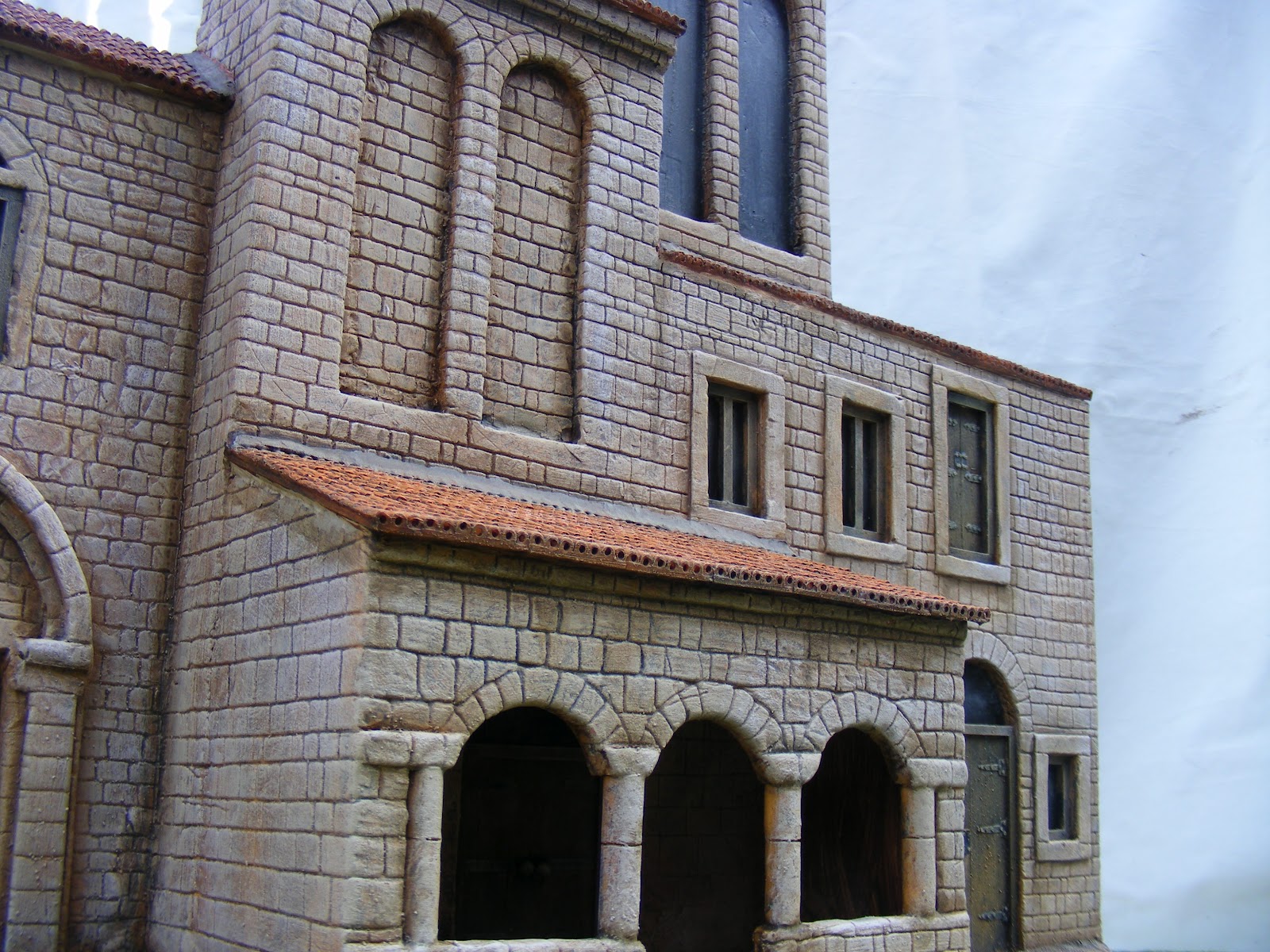
I wanted to do something set in Southern Europe as there are a few ranges around now that can use that sort of terrain. This is designed as a shelf display with it being only 6" deep. I used a photograph of a real building for inspiration with the front arches particularly catching my eye. The stone work is carved Daz Pronto air dried clay and the pan tiles are resin sheets that I have had made for me. I was going to use some other tiles but when I came to it I hadn't got enough.
This was inspired by a planned larger diorama for a customer that involves a sentry box. I really liked the idea and thought it would make an excellent stand alone piece. The arm works and most of it is made from balsa wood except the arm which is stronger pine dowelling. I really enjoyed painting the stripes.
This model was inspired by a discussion I had with a potential customer who wanted a Roman watch tower. I thought it would make a good piece to add to any Roman display so I thought I would give it a go.I made a frame of foam board but the rest is balsa wood including the individual tiles on the roof.
I always enjoy making these sort of buildings. They are perfect for the Wild West but will also fit in American Civil War layouts- a small town street scene. I haven't put any signage on to limit where they can be used. They are shelf displays with no detail on the back and only being about 6 inches deep. The windows are from my own resin collection and everything else is balsa.
While I was thinking what to do I suddenly got an urge to do part of Fort Tichonderoga. This is the main gate. There should be a garrison building behind the wall but I haven't added it to keep things reasonably simple. It seems the fort had a foundation of stone with the plan to build it all in stone eventually but the upper parts of the walls never got replaced from the original log construction. This is a surprisingly long piece- over 18" long so should make an impressive display with some John Jenkins French Indian War figures.
That is it for now with the photos. There is more that will be around on the day and there will be a model of Trostle farm, its barn and waggon shed as it was during the Battle of Gettysburg. This is for a customer and I have promised not to show him photos until he sees the real thing so I don't want to risk him seeing them here. There will be an article in the Toy Soldier Collector magazine later this year all about it but I will do a separate post just about that next week, after the show.
All these items are for sale at the show. If you have seen anything here that you want but can't make London then email me and if I still have it after the weekend we can sort out a sale then. If you are coming to the show then come over and have a look- they always look better in the flesh. I have things for sale to suit all pockets!
In past shows, we have been selling toy soldiers or getting rid of old stuff but this show is the first one of a new approach. I no longer have soldiers to sell so my stand is full of terrain. It takes alot of time to fill 12 feet of space with scratch built 1/30th scale terrain pieces. I just about got finished today and here are photos of the results:
| most of it grouped together |
I wanted to do something set in Southern Europe as there are a few ranges around now that can use that sort of terrain. This is designed as a shelf display with it being only 6" deep. I used a photograph of a real building for inspiration with the front arches particularly catching my eye. The stone work is carved Daz Pronto air dried clay and the pan tiles are resin sheets that I have had made for me. I was going to use some other tiles but when I came to it I hadn't got enough.
This was inspired by a planned larger diorama for a customer that involves a sentry box. I really liked the idea and thought it would make an excellent stand alone piece. The arm works and most of it is made from balsa wood except the arm which is stronger pine dowelling. I really enjoyed painting the stripes.
This model was inspired by a discussion I had with a potential customer who wanted a Roman watch tower. I thought it would make a good piece to add to any Roman display so I thought I would give it a go.I made a frame of foam board but the rest is balsa wood including the individual tiles on the roof.
I always enjoy making these sort of buildings. They are perfect for the Wild West but will also fit in American Civil War layouts- a small town street scene. I haven't put any signage on to limit where they can be used. They are shelf displays with no detail on the back and only being about 6 inches deep. The windows are from my own resin collection and everything else is balsa.
While I was thinking what to do I suddenly got an urge to do part of Fort Tichonderoga. This is the main gate. There should be a garrison building behind the wall but I haven't added it to keep things reasonably simple. It seems the fort had a foundation of stone with the plan to build it all in stone eventually but the upper parts of the walls never got replaced from the original log construction. This is a surprisingly long piece- over 18" long so should make an impressive display with some John Jenkins French Indian War figures.
That is it for now with the photos. There is more that will be around on the day and there will be a model of Trostle farm, its barn and waggon shed as it was during the Battle of Gettysburg. This is for a customer and I have promised not to show him photos until he sees the real thing so I don't want to risk him seeing them here. There will be an article in the Toy Soldier Collector magazine later this year all about it but I will do a separate post just about that next week, after the show.
All these items are for sale at the show. If you have seen anything here that you want but can't make London then email me and if I still have it after the weekend we can sort out a sale then. If you are coming to the show then come over and have a look- they always look better in the flesh. I have things for sale to suit all pockets!
Subscribe to:
Comments (Atom)